
Notable Figures
During the period covered by this site (ca. 1750–1930), the African American community of Goldsboro was shaped by numerous civic, religious, business, and cultural leaders. However, relatively few of these individuals were documented in the historical record, as most collecting institutions of the time did not prioritize preserving Black histories. The limitations of early photography—introduced in the United States in the 1840s—further contributed to this absence, as many African American families lacked access to such technology due to its cost. As a result, both biographical information and visual documentation of notable Black figures remain limited. Ongoing research continues to uncover and restore these histories, and additional individuals will be added to this site as they are identified.
Goldsboro's First Baby Nurse
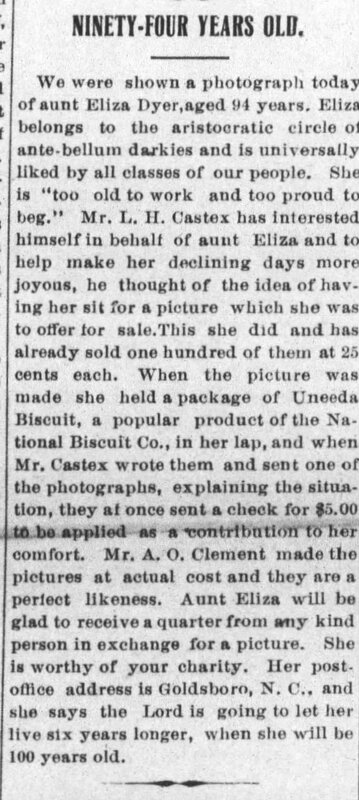
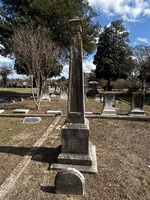
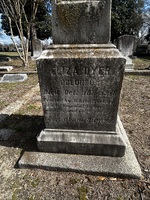
Eliza Dyer (1814-1910)
Eliza Dyer was Goldsboro's first baby nurse. This 1907 photograph was taken by A.O. Clement and sold for .25 cents (nearly $9.00 today), to help raise money for her to retire in comfort. Dyer at age 96, in the photo, was no longer able to work. In the photo, Dyer was holding a box of "Needam Biscuits" so Clement sent a photo to the biscuit company and they returned $5.00 (approximately $175.65 today) to contribute to her care.

Attorney
George T. Wassom (1849-1932)
George T. Wassom was an African American lawyer and publisher and editor for the Goldsboro Star newspaper, a bi-weekly newspaper that began in 1881. Wassom was an active member of the Republican Party. Wassom was the attorney that represented Noah Cherry during his trial for murder in 1878.
In 1889, Wassom was among several Black leaders in North Carolina who spoke out against the conditions facing African Americans and encouraged migration to Kansas and Arkansas. A special orders report from the state militia’s adjutant general noted that Wassom distributed a circular in Goldsboro warning that cotton belt landowners were creating a system of economic dependence he believed could become even more restrictive than slavery.
His actions drew the attention of Governor Daniel G. Fowle, who sent Brigadier General W. H. Anthony to Goldsboro to investigate and maintain order if needed. The Wilmington Messenger later reported on a Raleigh meeting attended by Wassom, where participants were told that thousands of Black laborers were wanted in Arkansas and that travel costs were relatively low. Despite these concerns, no unrest or retaliation against Wassom was recorded.

This page is part of an ongoing effort to research, document, and interpret the histories represented here. As new evidence emerges, content will continue to be expanded to reflect a more complete and inclusive historical record.
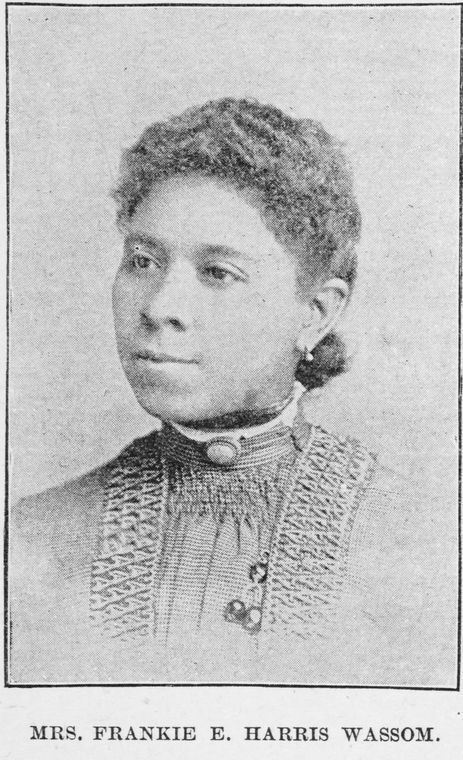
Frankie E. Harris Wassom was the wife of Colonel George T. Wassom. Frankie was a teacher, a poet, a musician and an artist. Although, not from Goldsboro, she trained African American teachers as well as helped run the newspaper Goldsboro Star along side of her husband.