
Noah Cherry (1878)
The morning of February 12, 1878, Noah Cherry located the bodies of Mr. James Worley and his wife lying in the yard of their property. The couple had been brutally killed in front of their three small children. The children remained physically unharmed, and the oldest would give the name "Noah" when asked if she knew who committed the heinous acts. Noah Cherry, Harris Atkinson, and Robert Thompson would stand trial and be hanged. A fourth defendant named Jerry Cox turned state’s evidence and was spared. He would go on to murder a woman just a few years later and be imprisoned while awaiting trial. He started a fire in his cell and caused the jail to burn down with him still inside.
Through an analysis of historical documents, newspapers, and later interpretations, this project’s goal is to demonstrate that the conviction and execution of Noah Cherry may have been shaped by the racial and legal inequalities of Reconstruction-era North Carolina. Locating and documenting his burial site is therefore an act of historical recovery that challenges incomplete or biased narratives and restores dignity to those buried in the cemetery.

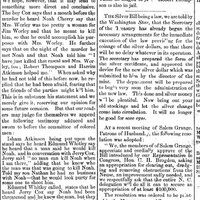

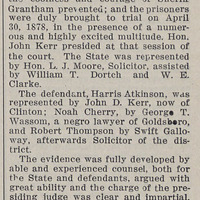
Looking for Burial Location
In War-Time Reminiscences and Other Selections, James M. Hollowell identifies the location where Noah Cherry and Harry Atkinson were buried following their execution. Decades later, in 1955, Moses Rountree published an article in the The News & Observer titled “This Case Stirred Wayne County.” In that piece, he notes that “Cherry was buried on ‘Hangman’s Hill,’ adjoining a hog pasture west of Goldsboro, now just off Park Avenue, a residential thoroughfare.” Rountree further references Hollowell’s account, indicating that the site became a cemetery for Black residents after the Civil War. This Rountree reference is shown in Sherwood Williford’s work (pp. 280–285), though a digital copy of this source is not currently available online.


The map below is depicting location pins for several written record mentions of the cemetery that was used for African Americans after the Civil War. Research is ongoing and the page will be updated as information is found.

This page is part of an ongoing effort to research, document, and interpret the histories represented here. As new evidence emerges, content will continue to be expanded to reflect a more complete and inclusive historical record.