About
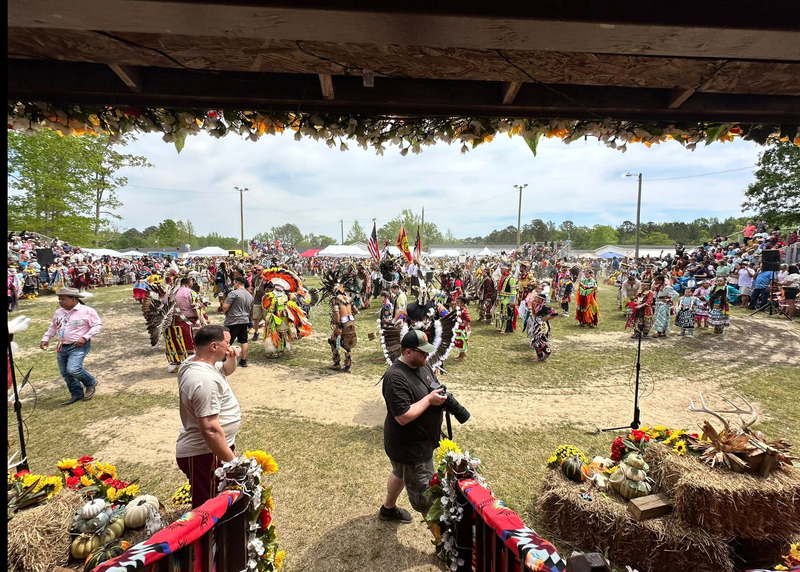
This project, started during the Spring of 2024, is a collaborative community archive that strives to document the outward cultural expression of Native American tribes in the Southeastern United States at their local powwows and other public cultural events.
It will also intend to achieve to raise cultural awareness of Native American tribes and communities in North Carolina and Virginia.
This project aims to create a researchable online resource for schools and Native American communities.
Many photographs are donated by members of tribal communities, local professional and hobbyists photographers, and various members of the public.
Tribes highlighted in this collection are specific to North Carolina and Virginia.
Out of respect for the participants in the photos, identities are not provided.
If interested in donating pictures from your own collection, please email them to Travis Dunn at Travisjd93@aol.com. Participants are also encouraged to join the project associated Facebook Group, Southeastern Powwow Photo Project (NC &VA), to upload photographs and to view photographs that have been shared by the participant community. Please include the event name, when the picture was taken, and who took the picture. Facebook group link: Southeastern Powwow Photo Project (NC &VA).
Brief Historic Overview of Powwows in North Carolina
Known as a Native American gathering whether by one tribe or more, derived from the Algonquin language word for gathering, “pau pau” or “powwow” has become synonymous with Pan-Indian cultural expression in Native American tribes. “Pan-Indian activities are defined as cultural patterns that cut across traditional tribal boundaries to unite people in a wider, regional or national identity”.1 “Powwow as we know it today developed during the 1920s and 1930s at intertribal gatherings in Montana, South Dakota, Oklahoma, and New Mexico… By the 1960s, a standard powwow format had developed and the Indian rights activism of the era helped spread powwows throughout the country”.2 The powwow traditions are not all from the host tribe, most songs and dances come from the cultural traditions of Western tribes. The Haliwa-Saponi Tribe of North Carolina held the first modern powwow in the state in April 1967.3
The powwow arena became a sphere for asserting cultural recognition to the surrounding communities and thereby raising awareness of having “living Indians” in the state. “In 1973 North Carolina governor Jim Holshouser, as well as representatives from the Cherokees, Lumbees, Seminoles, Creeks, Narragansetts, Mattaponis, and Chickahominies, attended the event, which drew about five thousand visitors, including many non-Indians”.4 Native American identity has been supported by community efforts to hold on to what Native American traditions are left to learn and pass on to the next generation, and powwows have acted as a conduit for which traditional cultural knowledge is maintained through outward cultural expression.
Scholars of American Indian Studies have long been researching approaches as to study the original people of the Americas. Much of the field’s original purview originates with the pure fascination of the idea of a vanishing race of “Indians”. Edward Curtis’ work The North American Indian, Vol. 1, 1907 intentions were to document Native American lifeways before colonization and assimilation.5
This project will document the ever changing and growing outward expression of culture in the local Native American communities. A culture that is thriving and evolving today, because Native Americans are still here.
1Lerch, Patricia Barker, and Susan Bullers. “Powwows as Identity Markers: Traditional or Pan-Indian?” Human Organization 55, no. 4 (1996), p.390.