Funerary Relief of Abuna, Daughter of Nabuna (ca. A.D. 170–230)
Item
-
Title
-
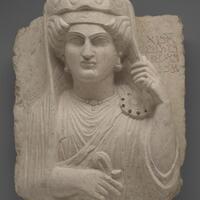
Funerary Relief of Abuna, Daughter of Nabuna (ca. A.D. 170–230)
-
Description
-
From the Yale Art Gallery: "This limestone relief shows the bust of a woman elegantly dressed in a tunic and cloak, the latter garment pulled up over the back of her head to form a veil, which she holds back from her face with her left hand. Between the thumb and forefinger of her right hand, she holds the end of the cloak, which envelops her right arm.
She wears several pieces of jewelry, including a large, round brooch pinned to her left shoulder; two rings on the pinky of her left hand; a necklace with an ovoid pendant; a pair of large earrings; and a headdress with geometric and floral ornament. Wavy locks of hair flow from beneath the headdress out toward both sides of her head, disappearing behind the veil. Her very large, almond-shaped eyes, with incised irises and pupils, are the most prominent features of her full face.
An inscription in Aramaic over her left shoulder identifies the woman: "Abuna, daughter of Nabuna, son of Anini. Alas!" Such inscriptions, celebrating the subject's family lineage, are common on Palmyrene reliefs, which served as grave markers for those wealthy enough to afford sculpted funerary monuments.
For much of the second and third centuries A.D., Palmyra's merchant class amassed considerable wealth, capitalizing on the city's location along an important Near Eastern trade route. Like much ancient sculpture, these reliefs were originally painted to heighten their immediacy. Traces of red paint remain visible on this relief."
-
https://artgallery.yale.edu/collections/objects/4535
-
Language
-
Palmyrene Aramaic Inscription:
"Abuna, daughter of Nabuna, son of Anini. Alas!"
-
Physical Dimensions
-
20 11/16 × 16 15/16 × 7 11/16 in. (52.5 × 43 × 19.5 cm)
-
Source
-
Yale University Art Gallery
-
Identifier
-
1930.6

 YAG 1930.6