Items
-
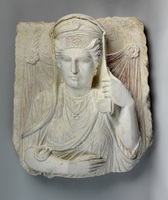 From the University of Pennsylvania Museum of Archaeology and Anthropology: "Square inscribed loculus relief with bust of woman in frontal position. Right arm is bent across front of body; left arm is bent grasping edge of veil. The woman wears a tunic and mantle pinned over the left shoulder with a circular brooch; the mantle falls in a broad curve below the right breast and has a loop on the bare right forearm. She wears a diadem with a palm motif at the center, a twisted turban, and a veil over the top of her head. Her hair is drawn back in locks from the sides of the face, disappearing beneath the veil. Several long locks fall over her right shoulder. She wears two necklaces: a rolled necklace with a small jewel hanging from it and a chain with a crescent pendant with knobs on the ends. On the little finger of her left hand are two rings with tiny stones set. She has cheekbones and broad, flat cheeks. The forehead is high with eyebrows on sharp ridges; prominent almond-shaped eyes, with a thickened ridge for the upper lid, overlapping the lower; raised circle with an incision around the perimeter for the iris; drilled dot for the pupil; emphasized lacrimal gland. Flattened nose bridge with broad nostrils. Indentation between nose and mouth. Small mouth with thick lower lip and deep indentation separating lips; small projecting chin; strong jawline. The background is a dorsalium or curtain hanging from a rosette on each side, with a palm branch above each. Inscription in four lines to the right of the head: "Yedi 'at, daughter of Si'ona, son of Taime, Alas!" Traces of pinkish-red pigment on the dorsalium, the inscribed letters, the diadem, and the turban."
-
 From the Met: "This relief is a type of funerary monument characteristic of the prosperous caravan city of Palmyra during the first three centuries A.D. Reliefs with a representation of the deceased and a short identifying inscription were used to seal burial niches in elaborately decorated communal tombs; those with a half-length or bust format became prevalent sometime after A.D. 65. The relief depicts the upper body of a woman in a draped garment, pinned at the left shoulder with an elaborate brooch, facing directly toward the viewer. Her hair is gathered up at the temples and covered by a turban-like headdress, worn over a richly patterned diadem that covers her forehead. Pendant earrings shaped like dumbbells, perhaps representing two pearls or beads connected by a vertical rod, hang from her earlobes; the lower ball of each earring remains connected to the stone on either side to protect this delicately carved detail from breaking. She wears a long veil over her head and holds its edge at shoulder level with her right hand, while the voluminous fabric wraps around the left arm, leaving only the hand exposed. The left hand holds a looped fold of the veil. Over her left shoulder, an inscription in Palmyrene Aramaic records her name and her father’s name, against a blank background. Her expression is serene, and her gaze does not meet the viewer’s but looks far into the distance. The iris and pupil are marked with incised concentric circles, and the eyebrows are indicated by simple incised lines. Her small, thin-lipped mouth is pursed in a faint smile. Chips and cracks in the surface result from the use of soft local limestone. The relief can be stylistically dated to around 150-200 A.D. because of the hairstyle and the arrangement of her hands and veil."
-
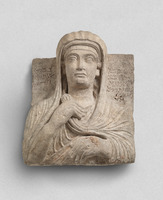 From the Met: "This relief is a type of funerary monument characteristic of the prosperous caravan city of Palmyra during the first three centuries AD. Reliefs depicting the deceased and a short identifying inscription sealed burial niches in elaborately decorated communal tombs; half-length or bust formats became prevalent after A.D. 65. The relief depicts the upper body of a woman in a draped garment, facing directly toward the viewer. A turban-like headdress covers her hair, worn over a diadem that covers her forehead. Curls at the temples gather over the diadem and under the headdress, while long, wavy locks fall to either side of her neck, reaching her shoulders. She wears a long veil over her head, covering the left arm and leaving only the hand exposed. The right forearm is bare, and the hand draws a looped fold of the veil over the chest from the left side. Her expression is serene, and her gaze does not meet the viewer’s but looks far into the distance. The iris and pupil are marked with incised concentric circles, and the eyebrows are indicated by modeled ridges. Softly modeled cheeks frame her small, thin-lipped mouth. An inscription in Palmyrene Aramaic, visible over both shoulders, gives her name and her husband’s name, and records her date of death. The months of the Palmyrene calendar were based on the earlier Babylonian calendar, while the years were reckoned according to the Seleucid era, which began in 312 B.C."
-
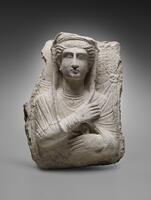 From the Yale Art Gallery: "This electronic record was created from historical documentation that does not necessarily reflect the Yale University Art Gallery’s complete or current knowledge about the object. Review and updating of records are ongoing."
-
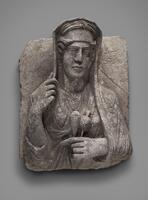 From the Yale Art Gallery: "This electronic record was created from historic documentation that does not necessarily reflect the Yale University Art Gallery’s complete or current knowledge about the object. Review and updating of records is ongoing."
-
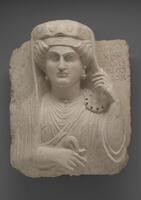 From the Yale Art Gallery: "This limestone relief shows the bust of a woman elegantly dressed in a tunic and cloak, the latter garment pulled up over the back of her head to form a veil, which she holds back from her face with her left hand. Between the thumb and forefinger of her right hand, she holds the end of the cloak, which envelops her right arm. She wears several pieces of jewelry, including a large, round brooch pinned to her left shoulder; two rings on the pinky of her left hand; a necklace with an ovoid pendant; a pair of large earrings; and a headdress with geometric and floral ornament. Wavy locks of hair flow from beneath the headdress out toward both sides of her head, disappearing behind the veil. Her very large, almond-shaped eyes, with incised irises and pupils, are the most prominent features of her full face. An inscription in Aramaic over her left shoulder identifies the woman: "Abuna, daughter of Nabuna, son of Anini. Alas!" Such inscriptions, celebrating the subject's family lineage, are common on Palmyrene reliefs, which served as grave markers for those wealthy enough to afford sculpted funerary monuments. For much of the second and third centuries A.D., Palmyra's merchant class amassed considerable wealth, capitalizing on the city's location along an important Near Eastern trade route. Like much ancient sculpture, these reliefs were originally painted to heighten their immediacy. Traces of red paint remain visible on this relief."
-
 From the Met: "This relief is a type of funerary monument characteristic of the prosperous caravan city of Palmyra during the first three centuries A.D. Reliefs with a representation of the deceased and a short identifying inscription were used to seal burial niches in elaborately decorated communal tombs; those with a half-length or bust format became prevalent sometime after A.D. 65. The relief depicts the upper body of a woman dressed in a draped garment, pinned at the left shoulder with an elaborate brooch, who faces directly towards the viewer. Her hair is covered by a turban-like headdress, made up of a wrapped cloth with a twisted border, worn over a diadem that covers her forehead. Long, wavy locks of hair fall behind her ears to her shoulders. Tiny plain rings cover the outer rims of her ears. She wears a long veil over her head which covers both arms, leaving only the hands exposed. The left hand holds a spindle and distaff, tools for spinning wool into yarn, which are associated with women’s domestic work. The right hand is held raised with the palm facing out, a gesture which may have been protective and is frequently seen on women’s funerary portraits from Palmyra. Her expression is serene, and her gaze does not meet the viewer’s but looks far into the distance. The iris and pupil of the eye are marked by incised concentric circles, and the eyebrows are indicated by modeled ridges. Her small mouth is framed by delicately modeled cheeks and chin, with the horizontal lines across the throat adding to the impression of fleshy softness. The relief can be stylistically dated to about 50-150 A.D. because of the hairstyle, and the patterned folds of the garment. An inscription which appears over her right shoulder, difficult to decipher, may have been added later."