A Desk of Memories
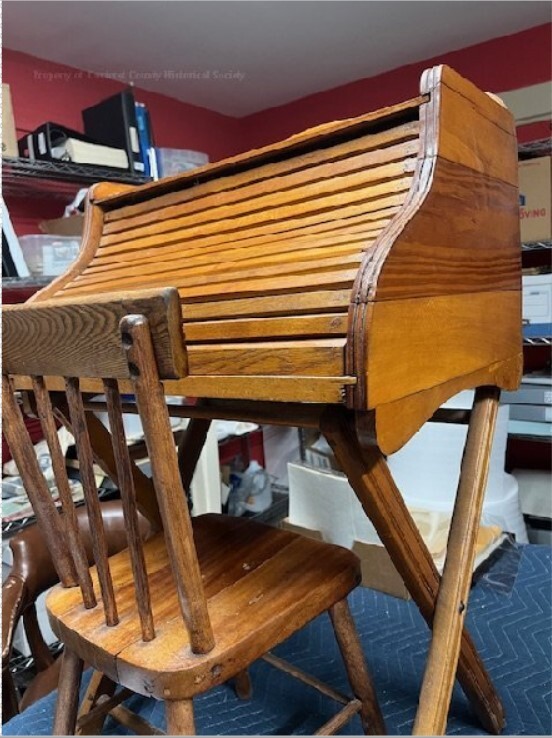
The desk featured above is an artifact that originated on Portsmouth Island and is currently held at the History Museum of Carteret County. Through examining its story, one can learn a bit about the people of Portsmouth, the life they had there, and how that history is being remembered.
When people think of artifacts and pieces of history that have been passed down and preserved, the imagination can sometimes lean towards the more fantastic: weapons passed down from soldiers, tools passed down from workers, toys passed down from ancestors who were once children too, etc. Many times, however, history is found in what appear to be simple and mundane, everyday items. One of these items that may be dismissed at first glance is an undersized desk and chair, appearing to either be made for some type of display or for a child, based on its size. It is smooth to the touch, and you can see the grain and natural design of the wood that was used to make it on top and front, highlighting a natural style that is common with objects made from wood or faux wood. Its style is that of a roll-type, where the desk itself can be shut with rolling slats of wood, with a small metal lock serving to hide away its contents from unwanted visitors.
Opening the desk reveals a unique aspect in its design, the fact that the rolling slats are a mirage; instead of being slats that roll into the back of the desk when pushed open, it is all one piece that pushes upward to reveal the inside of the desk, with the front being fashioned to resemble slats. Inside the desk, the natural wooden design is interrupted by a black set of baseboards, only stopping where the drawer of the desk comes down, where the natural wood style resumes. In the back lies a small wooden chalk organizer that is nested into place, though it now lies empty. On the left side of the interior of the desk, one can see a small set of crayon scribbles, perhaps telling the story of a child playing around with their crayons or even accidentally missing the drawing they were attempting to make. The legs of the desk look far more like they would be at home on a luggage rack rather than a desk, with only a small wooden bar stretching across the front legs to form a footrest, truly setting them apart, but they do their job of keeping the desk upright and stable. The chair that accompanies the desk is child-sized as well, in a style commonly known as Windsor. The backboard of the chair is held up by five poles, with the two outer ones being more heavy-duty than the three inner ones, while the backboard itself consists of a rectangular board with two sets of small grooves cut into the board. The top of the board that lies above these grooves is fashioned in such a way that the grain of the wood makes an almost wavelike pattern that stretches across the board, marking a great example of the natural style. Together, the chair and the desk make an excellent little pairing, painting the scene of a child’s desk that no doubt saw use.
While they both have been refurbished and repaired, the original version of this desk and chair pairing was brought to life right around the year 1913, right before the world would become embroiled in the First World War. The maker of the items was Willis Monroe Gilgo, a resident of Portsmouth Island. He brought to life the original versions of the desk and chair using scrap wood and cigar boxes for his five-year-old daughter at the time, Ethel Gilgo. A father creating a gift for his daughter using what material he had is a heartwarming story by itself, but the legacy that the gift has left in the family perhaps brings more emphasis on the effects that this gift had on Ethel. The desk remained in the Gilgo family, making the exodus from Portsmouth Island with them and being passed down until it came into the possession of Kim Reilly, granddaughter of Ethel and great-granddaughter of Willis Monroe. It was in this more modern era that repairs and refurbishments were conducted by a Mr. McDonnell with a focus on retaining as much of the original vision of the desk as possible. Kim then saw fit to donate the item to the History Museum of Carteret County and share its history with the staff in 2024, and the staff saw fit to put the item on display in its own case, highlighting its history and showcasing the recent arrival of artifacts and stories into the Museum. The children’s desk and chair represent a deeply personal and direct link to the history of family, one that brings the more academic side of history to life in the physical domain. It shows a father’s love for his daughter, a daughter’s appreciation for her father, and a family’s commitment to its legacy.
Too often in this profession, work is largely focused on the world of records, documents, archives, and old accounts. Many of these records tell fascinating stories and showcase incredibly important stories, but there is something about the more physical aspects of history, artifacts, landmarks, etc., that always seems to connect to people.
To see more about this Desk and other exhibits showcasing the history of Carteret County, one can visit the History Museum of Carteret County in Morehead City.