Death
Intro Paragraph
Skulls

Still Life (Vanitas) - Hendrick Andriessen (1637)
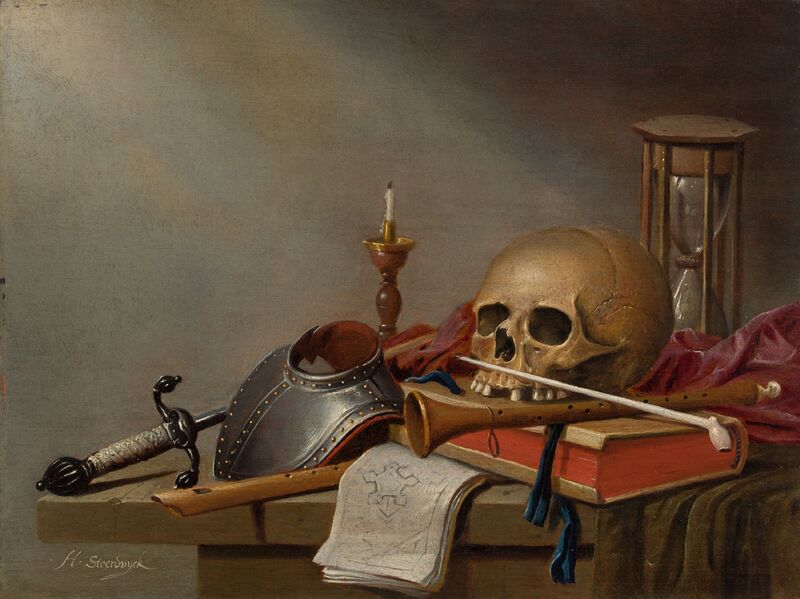
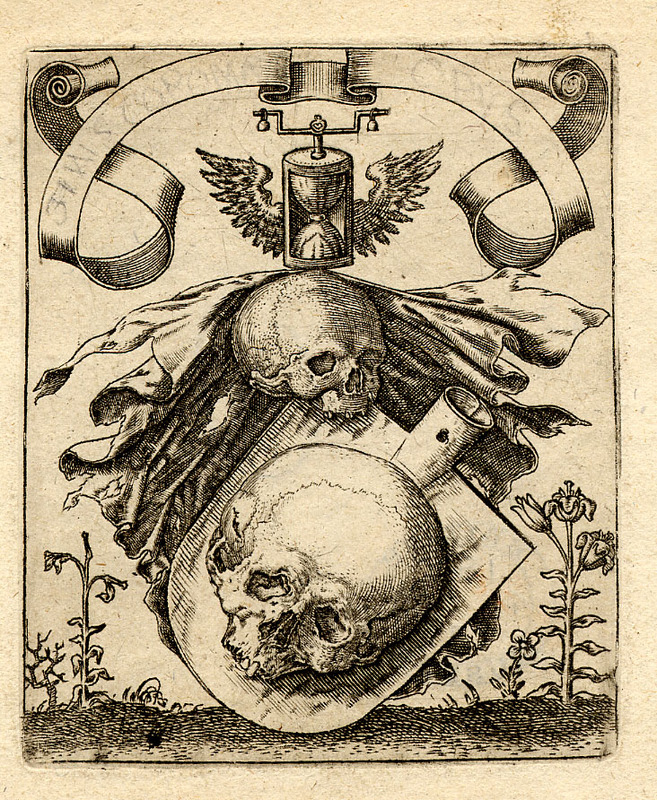
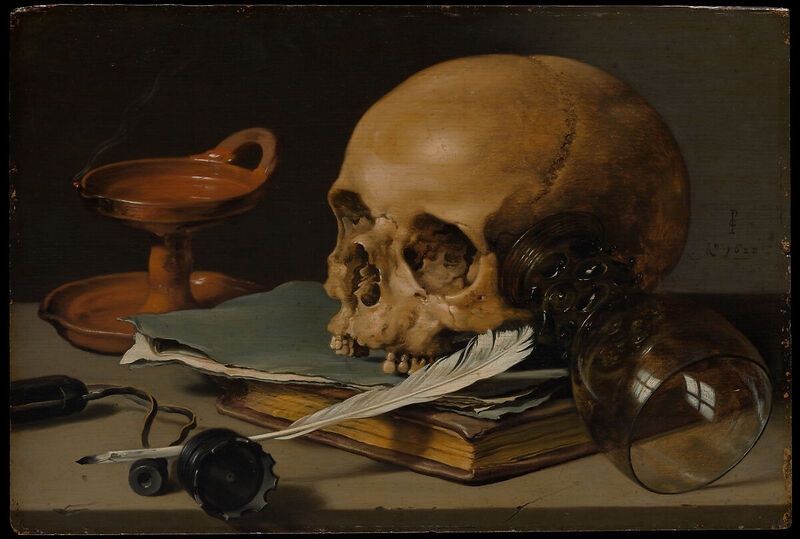
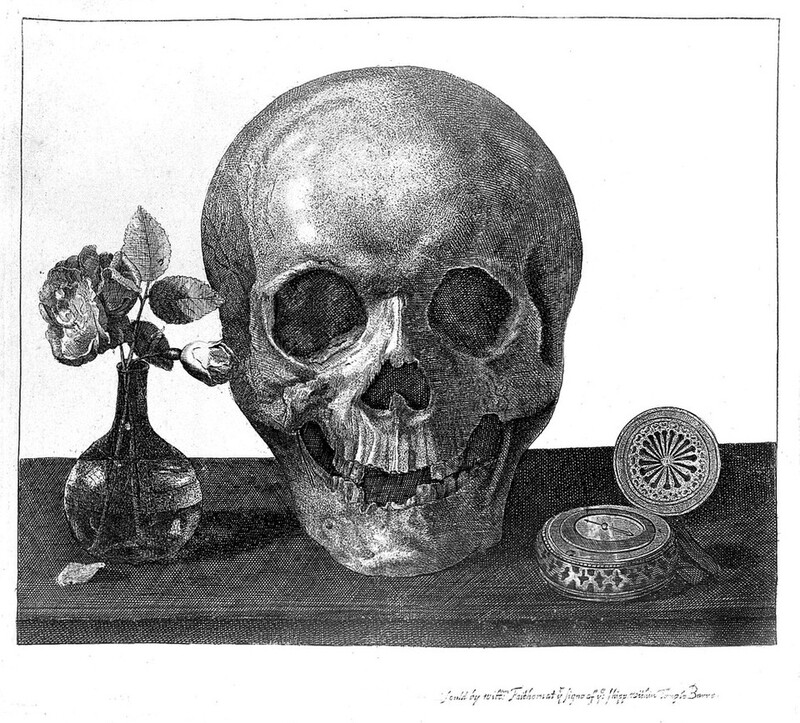
The most important, and often the most noticeable, details of Vanitas paintings are the representations of death. The appearance of a skull is largely considered to be the trademark of the genre, though many other symbols of death, often far more subtle, occur throughout these still life paintings. Anxiety over the final resting place of the human soul had long plagued European society, especially in the wake of the Black Plague, which struck down as many as one-third of the European population in the fourteenth century and continued to reemerge regularly well into the eighteenth century (Tuchman, 1978). The continued focus on death in art, from Memento Mori art pieces in the Medieval era to Vanitas paintings in the Early Modern era, showcase the uncertainty resulting from such an unpredictable and unescapable disease, exacerbated by religious tensions and radical shifts.
Molenaer displays several symbols for death and the transience of life. Foremost, Lady World has one gold-slipper resting on a skull. She clutches a mirror in her lap as her elderly attendant combs through her golden hair and a small child blows bubbles with obvious glee. There is an undeniably gentle, yet possessive air about the attendant and the way she caresses Lady World’s hair. Collier, too, includes a skull in his still life, tucked behind and propping up the open book. Additionally, the timepiece resting on the table as well as the hourglass hidden in the far right of the work allude to the inevitable passage of time. Utrecht’s skull is prominent, resting atop the closed book, but the fresh flowers contribute to the balance between life and death and the slow march of time, measured by the timepiece and hourglass he also included. Heda’s depiction of death, however, is unique. His still life does not contain a skull, nor any device to measure time, nor any greenery. Instead, a half-peeled orange sits, front and center, flanked by a plate of empty oyster shells.
The appearance of death symbolism in Vanitas paintings was intended to be a reminder of mortality. In the wake of the Reformation, where Calvin had posited that the fate of one’s soul was not determined by their actions in life and was instead gifted by God, death was thrown into sharp relief. Uncertainty pervaded nearly every aspect of society; the muddling of religious, cultural, and societal influences placed Reformation-era Western society in an anxious state. No longer were the duties of a citizen the same as the duties of a Christian; indeed, sometimes these two commitments actively opposed each other, and placing one over the other was not just a question of priorities. One’s very soul hung in the balance, a powerful motivator in the form of the Word of God and weaponized shame. Additionally, death symbolism, especially contrasted with scientific knowledge and worldly goods, served as a cautionary reminder that one’s worldly possessions would not tip the scales in their favor on judgment day.
The appearance of food in Vanitas paintings bridges the gap between material wealth and the inevitability of death and decay. Honig, however, emphasizes the special role of food in a more social, shared aspect. The symbolism of the food in these paintings, she argues, does not lie in its material wealth or commodification. Instead, the presence of a meal “invites us gradually to consider a whole range of presences: the hands that made the pie and those that cut it; the gestures that crafted the silver cup and the one that tipped it over” (Honig, 1998, p. 174). While food assuredly represented the wealth of the culture, depictions of meals have long been used to symbolize community. By showing oranges half-peeled, pies cut and half-eaten, and wine goblets spilled, Vanitas painters showed the “relative loosening of group formations in favor of a greater degree of individualism and personal autonomy, as occurred in most economically advanced urban centers in early modern Europe” (Honig, 1998, p. 175).
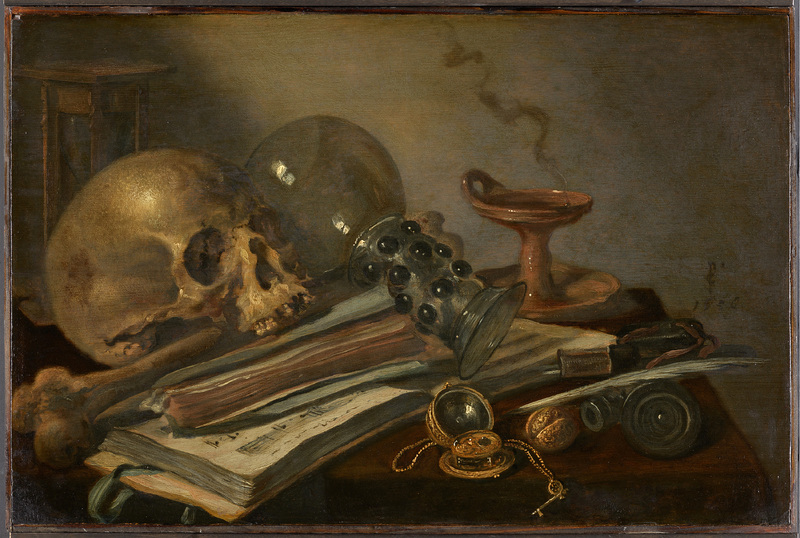
Vanitas - Pieter Claesz. (1656)
Flowers
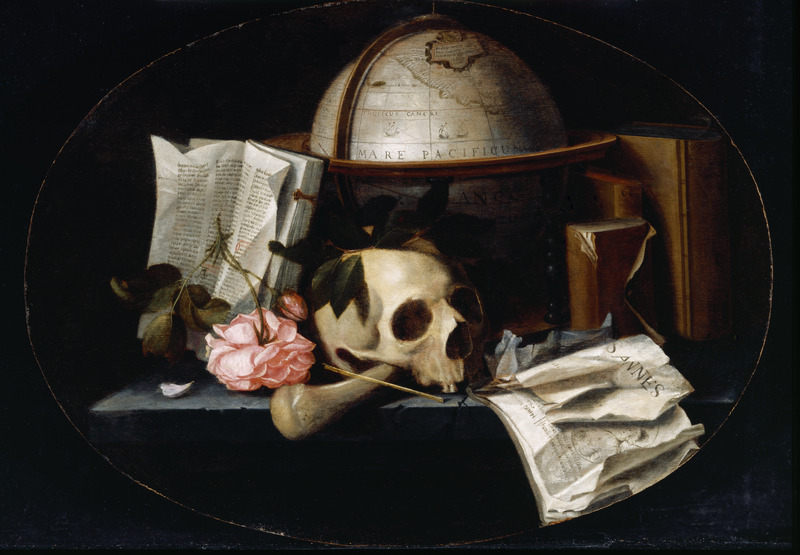
Vanitas - Johannes Borman (late 17th c.)
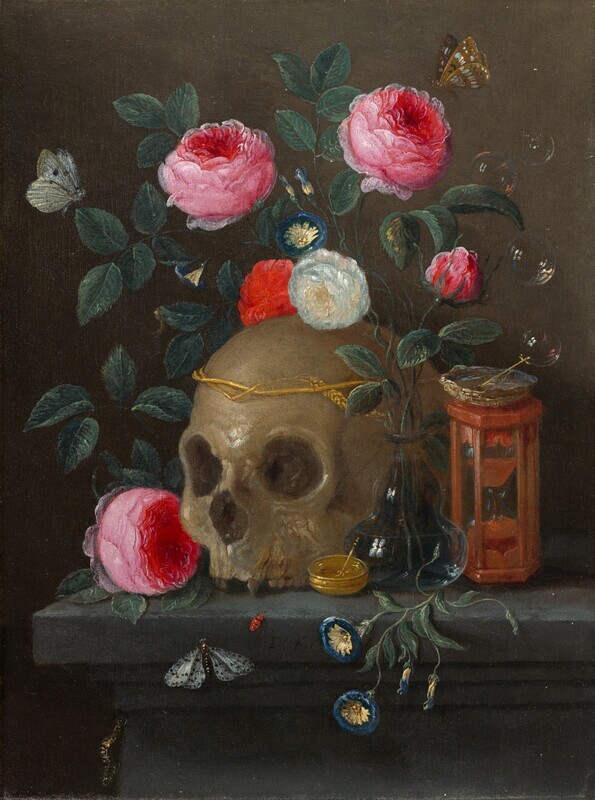
Vanitas Still Life - Jan van Kessel (1665)
Hourglasses
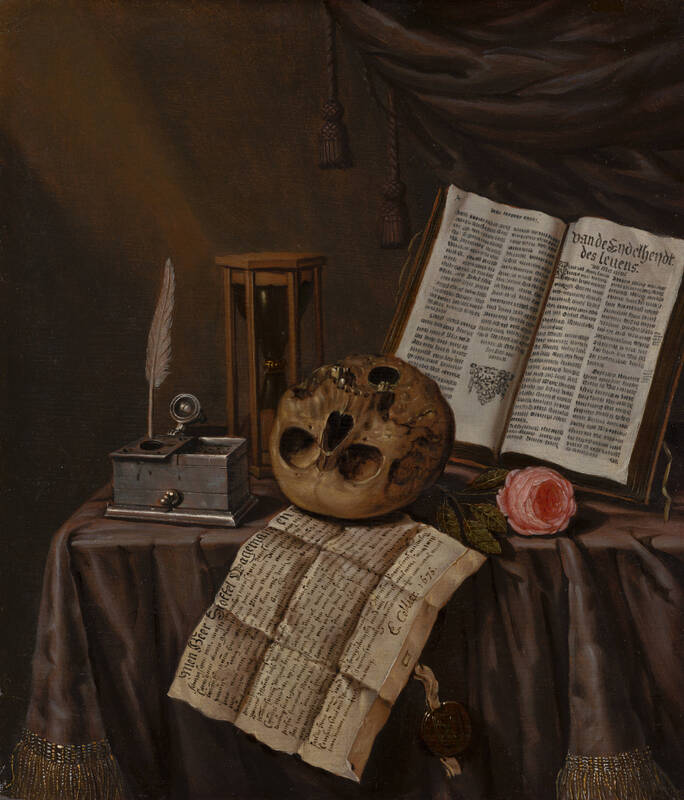
Vanitas Still Life - Edwaert Collier (1675)

Vanitas Still Life - Cornelius Norbertus Gysbrechts (17th c.)
Candles

Vanitas Still Life with Portrait of a Young Painter - David Bailly (1651)
A Vanitas Still Life - Harmen Steenwijck (17th c.)
-

-
 Book illustrationTheodoor de Bry
 -
 Still Life with a Skull and a Writing QuillPieter Claesz
 -
 A Skull with a Timepiece and FlowersWilliam Faithorne