
The Early Gay Liberation Movement
By Anna Roche
SOCI 4630, Spring 2023
What is the Early Gay Liberation Movement?
There has been constant social movement activity surrounding gay rights in the United States since the 1960's, and each surge of LGBTQ+ movement activity has had its own goals. I have classified the Early Gay Liberation Movement as the movement for LGBTQ+ rights starting in the 1960s, skyrocketing after the Stonewall protests in 1969, and continuing until the 1980's in which some of the first major Supreme Court Cases concerning sodomy laws were argued and the legal and social acceptance of LGBTQ+ people was increasing, especially in urban areas. The Gay Liberation Movement was a title used often to describe the LGBTQ+ movement at the time.
Who Led the Gay Liberation Movement?
Major leaders and organizations of the early Gay Liberation Movement
Bayard Rustin
Bayard Rustin was a prominent civil rights activist and an openly gay man. He helped organize the March on Washington and other major events in the Civil Rights Movement, but was also a major proponent of LGBTQ+ rights.
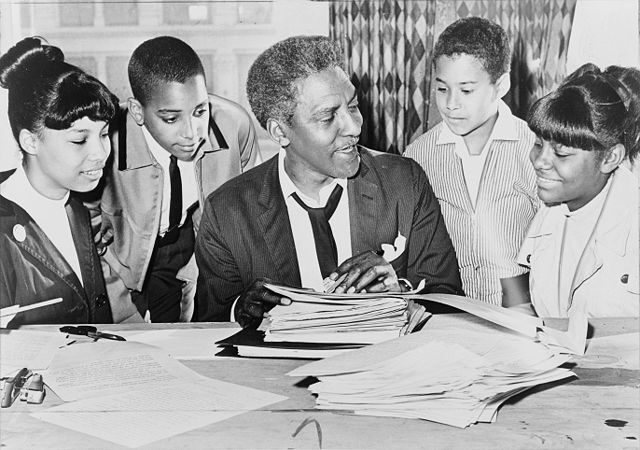
Bayard Rustin before a demonstration.
Bayard Rustin (center) speaking with (left to right) Carolyn Carter, Cecil Carter, Kurt Levister and Kathy Ross.
Harvey Milk
Harvey Milk was the first openly gay person to be elected to office in San Francisco, California in 1977. He was a prominent advocate for LGBTQ+ rights and was vocal about the need for LGBTQ+ people to push for change. He was assassinated in 1978 by a former San Francisco city supervisor.
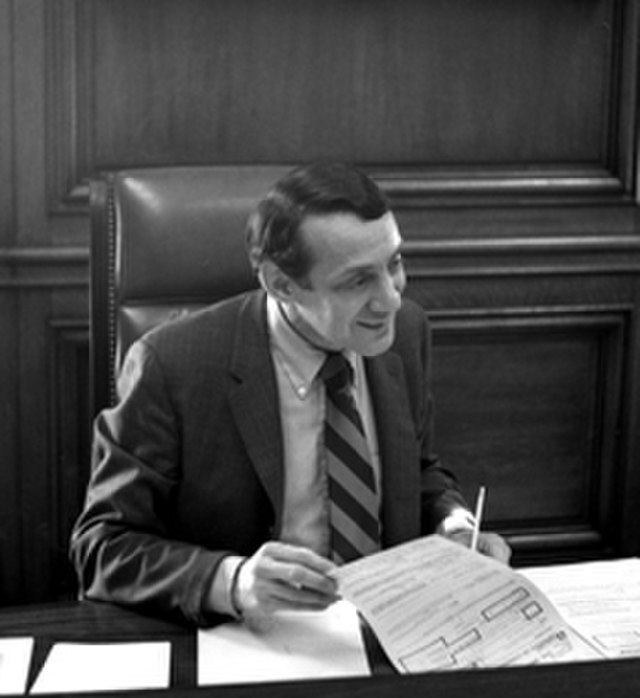
Harvey Milk at Mayor Moscone's Desk.
Harvey Milk pictured sitting at San Francisco Mayor Moscone's Desk filling in for him for a day.
The Daughters of Bilitis
This was the first lesbian rights group founded in the U.S., in 1955. The early founders in San Francisco included figures such as Rose Bamberger, Rosemary Sliepen, Phyllis Lyons, and Del Martin. The original founders consisted of Filipinas, Chicanas, and white women. As the group grew, chapters of The Daughters of Bilitis were established across the nation and their publication "The Ladder" became widely circulated within the lesbian community.
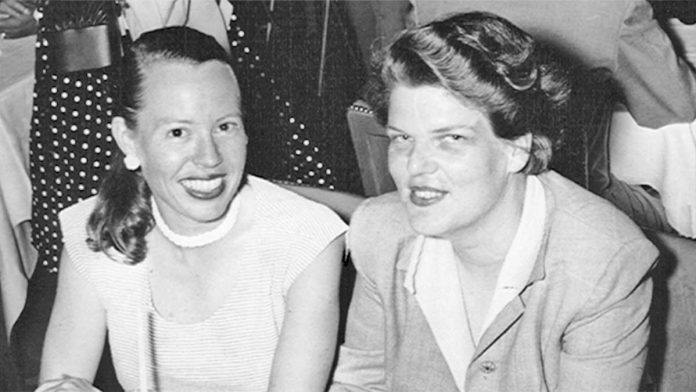
Phyllis Lyons and Del Martin.
Photograph of Phyllis Lyons and Del Martin from the 2003 documentary "No Secret Anymore: The Times Of Del Martin & Phyllis Lyon." Image via A.F. Archive/Alamy.
The Gay Liberation Front
This was one of the nations largest organizations at the start of the Gay Liberation Movement. Founded in New York in 1969 by Michael Brown and Dick Leitsch, it started as an offshoot of the Mattachine Society. The Mattachine Society was an early gay rights organization in New York, but the Gay Liberation Front quickly became its own entity. Organizers purposefully chose to use the word "gay" in the name of this organization, something that had been avoided by other organizations such as Mattachine or the Daughters of Bilitis. Though this organization was prominent and widespread, there was criticism of its primarily white and male membership, and People of Color and women often opted to form their own organizations.
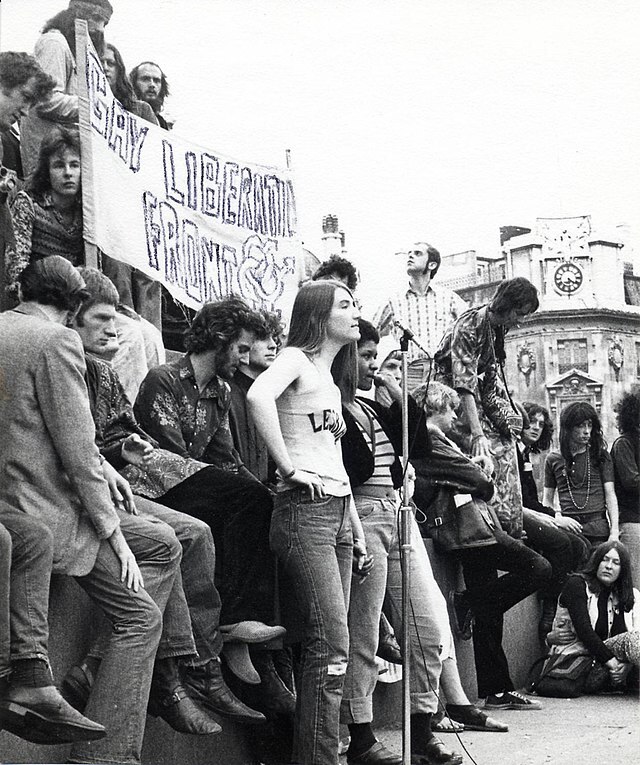
Demonstration with Gay Liberation Front Banner.
A photograph of a demonstration in London with a Gay Liberation Front banner visible ca. 1972.
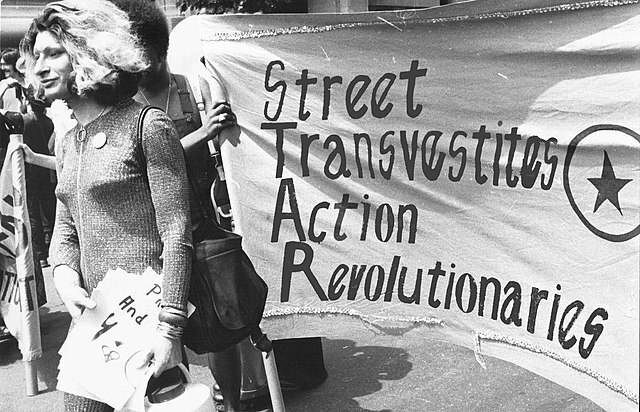
Street Transvestite Action Revolutionaries (STAR)
STAR was founded by Sylvia Rivera and Marsha P. Johnson in 1970 in New York City. This organization worked to provide resources, aid, and housing for transvestite (now referred to as transgender) people living on the streets of New York City as well as the unhoused population at large.
Mission of the Early Gay Liberation Movement
The Early Gay Liberation movement had many goals. Some included the decriminalization of homosexuality and transgender people, the normalization of LGBTQ+ people in society, and the right to marriage.
From the Gay Liberation Front's 1972 platform:
Our goal is to establish a society in which all people enjoy freedom of existence and freedom to relate to each other in whatever manner they see fit, without fears of oppression or condemnation.
Repression of the Early Gay Liberation Movement
Institutional Repression
There were many types of laws that repressed LGBTQ+ people and their movements. Laws banning sodomy criminalized gay sex, and were often used to criminalize any expression of affection between same-sex people. Places such as New York City made it illegal to serve LGBTQ+ people in bars, leading to constant raids of gay bars and the arrest of patrons and employees. Dancing in gay bars was also repressed. These both were done through declaring them "disorderly conduct." Gay bars became a center of LGBTQ+ communities and social networks, and local police used these laws as a way to prevent large groups of LGBTQ+ people from meeting. Gay people were not allowed to marry, serve in the military, and were denied many other rights. Homosexuality was also categorized as a mental disorder in the DSM-5 until 1973.
Stonewall
The Stonewall Inn was a poular gay bar in New York City's West Village. Its owners had ties to organized crime, and bribed the police to leave the bar alone, or if they did raid, to tip them off beforehand. On June 28th, 1969, the police did not give warning before they raided the bar. They arrested several patrons and treated them roughly, hitting one lesbian woman over the head as she was put into the van. As patrons fled the bar, many stayed behind as community members joined them and confronted the police, angry about the violence and injustice they were experiencing. The officers and a few others barricaded themselves in the Stonewall Inn, and protesters attempted to set fire to the building. The "Stonewall Riots" as they are now known, were a major catalyst for activism in the gay rights movement, and many of the major organizations described above were established in the aftermath of Stonewall.
Social Repression
Across the country, many people held anti-LGBTQ sentiments, just as people do today. Many Christians stated that the Bible declared homosexuality as wrong, and there was — and to a degree there is still today — a stigma surrounding homosexuality, even beyond its illegality. One person, Anita Bryant, was a major campaigner against LGBTQ+ rights. She was a famous entertainer, and after Dade County passed a pro-LGBTQ+ resolution, she founded the "Save Our Children" campaign in 1977. This campaign rebuked homosexuality and denounced it as sinful and a threat to children. This sentiment is still present in conservative rhetoric today.
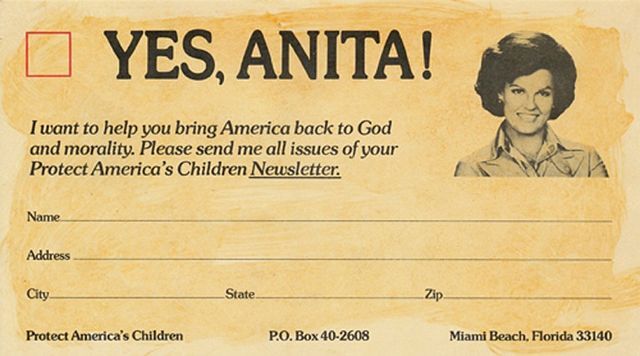
Save Our Children Fundraising Card
Photograph of a fundraising card for Anita Bryant's "Save Our Children" campaign from 1977.
Entertainment and Music of the Movement
Entertainers
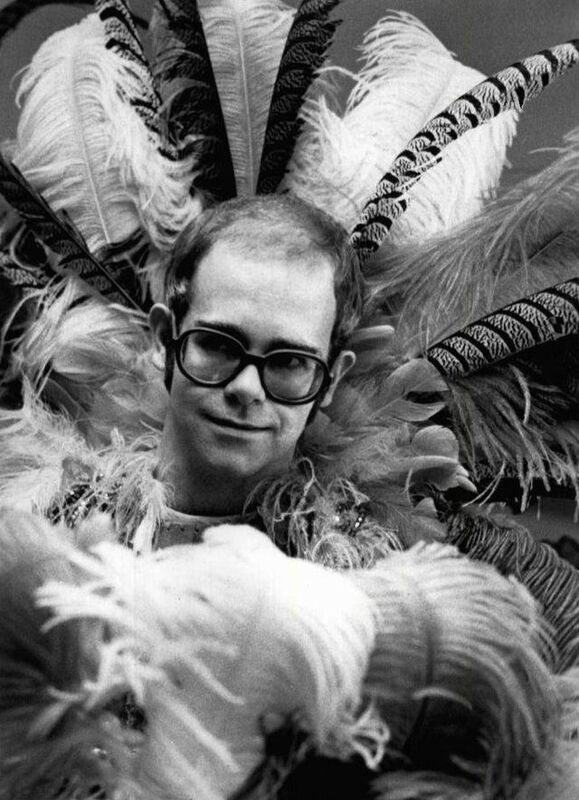
There were several prominent LGBTQ+ entertainers in the 1960s-1980s. Two of the most prominent are Elton John and Freddie Mercury. Both men's dress and expression subverted tradition ideas of the gender binary and gender roles, yet both became incredibly popular and beloved.
Music of the Movement
In the early Gay Liberation Movement, there were many songs that became "gay anthems" by artists that were not queer, or were not out. An example of this is Madonna's "Vogue." However, many songs by gay artists rose to prominence and began to be used by the movement.
I Want to Break Free
This song by Queen and its music video demonstrates a need to break free from society's norms, and was used by many in the Gay Liberation Movement to describe the need to break free from heteronormative and binary views of sexuality and gender. This video caused some controversy — MTV and other stations did not want to play it because the band was dressed in drag during the video and it was thought to be too controversial to play on such a popular station.
Sources & Further Reading
Fetner, T. (2001). Working Anita Bryant: The Impact of Christian Anti-Gay Activism on Lesbian and Gay Movement Claims. Social Problems, 48(3), 411–428. https://doi.org/10.1525/sp.2001.48.3.411.
Fitzsimons, T. (2018). LGBTQ History month: Early pioneers of the Gay Rights Movement. NBC Out & Proud. Retrieved from https://www.nbcnews.com/feature/nbc-out/lgbtq-history-month-early-pioneers-gay-rights-movement-n922031.
“Gay Liberation Front Platform Statement, December 2, 1970,” Digital Public Library of America, https://dp.la/item/278dba0fc139b3683a884bf1a5fc2662.
GLSEN. (n.d.). LGBTQ history timeline reference. Retrieved from https://www.glsen.org/sites/default/files/LGBTQ-History-Timeline-References.pdf.
HALL, S. (2010). The American Gay Rights Movement and Patriotic Protest. Journal of the History of Sexuality, 19(3), 536–562. http://www.jstor.org/stable/40986338.
History.com Editors. (2022). 1969 Stonewall Riots - Origins, Timeline & Leaders. Retrieved from https://www.history.com/topics/gay-rights/the-stonewall-riots.
Library of Congress. (n.d.). A Resource Guide: The Daughters of Bilitis. Research guides: LGBTQIA+ studies. Retrieved from https://guides.loc.gov/lgbtq-studies/before-stonewall/daughters-of-bilitis.
PBS. (n.d.). Anti-Gay Organizing on the Right. Out of the Past. Retrieved from https://www.pbs.org/outofthepast/past/p5/1977.html.
Stanford University. (2018). Rustin, Bayard. The Martin Luther King, Jr. Research and Education Institute. Retrieved from https://kinginstitute.stanford.edu/encyclopedia/rustin-bayard.
The New York Public Library. (n.d.). Gay Liberation Front (GLF). 1969: The Year of Gay Liberation. Retrieved from http://web-static.nypl.org/exhibitions/1969/liberation.html.
The Official Harvey Milk Biography. Harvey Milk Foundation. (n.d.). Retrieved from https://milkfoundation.org/about/harvey-milk-biography.