Natural History
Although the museum focuses on archaeology, there are several items that relate solely to the natural world. These items, while collected and valued by humans, do not have any indicators that show they were ever entangled with humans. Items include a prehistoric walrus skull, whale bones, and a prehistoric clam.
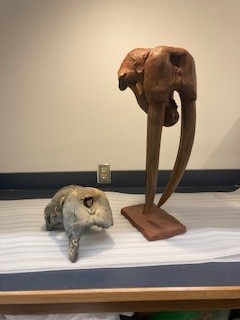
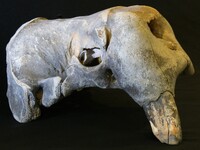
A prehistoric walrus skull was brought up in a shrimping net off Kill Devil Hills, North Carolina, in 1989. Estimated to be approximately 36,000 years old by the Smithsonian Institute after radiocarbon dating, the skull is in remarkably good condition with part of one tusk still intact. A walrus dated from the Last Glacial Period would have looked largely the same as modern walruses, except the tusks were much larger and longer in the prehistoric era.
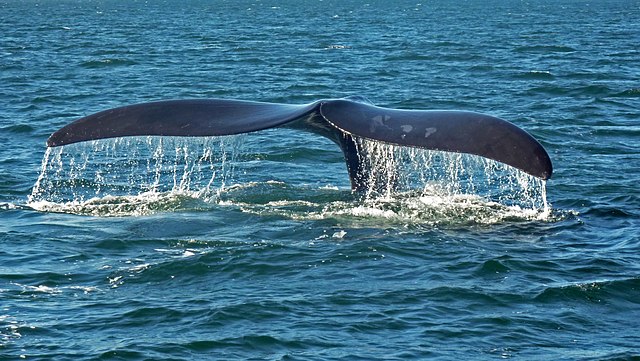
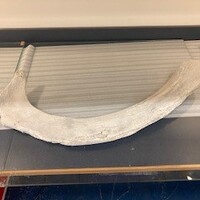
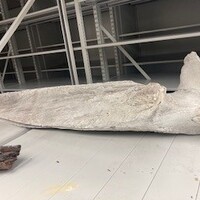
The whale bones in the museum's collection encompass two rib bones and two sections of a whale's lower jaw. They were discovered washed ashore on a Cape Hatteras beach and donated to the museum in 2008 and 2010, respectively.
Whale hunting in North Carolina existed from the 1700s until 1916, when whale oil was considered a valuable commodity. The Cape Hatteras whaling industry started with whales that had beached themselves and washed ashore, already dead. The oil rendered from whales was used to power lights, including the Cape Hatteras Lighthouse. Species common to North Carolina include sperm whales, right whales, humpbacks, and minke whales.
Once whales became over-hunted, other fuels, such as porpoise oil, were substituted. Cape Hatteras had a porpoise fishery, operating intermittently from 1793 to 1929. Porpoise oil was used for watches, chronometers, and industrial tools. Artifacts from the fishery can be seen in the newly renovated exhibit hall at the Graveyard of the Atlantic Museum.
To learn more about whales in North Carolina, visit Bonehenge Whale Center in Beaufort, North Carolina.
To read more about whales in recent news, follow these links:
- "Humpback whale that stranded on Pea Island found entangled in fishing gear," April 2024, Island Free Press (Hatteras and Ocracoke Islands, NC).
- "Minke whale found dead along the Outer Banks," March 2024, 13 News Now (Norfolk, VA).
- "Anglers find dead sperm whale stranded on remote N.C. beach," December 2023, Spectrum News 1 (Charlotte, NC).
- "30-foot humpback whale found on Outer Banks Beach, National Park Service says," December 2022, The News & Observer (Raleigh, NC).
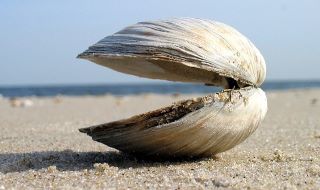
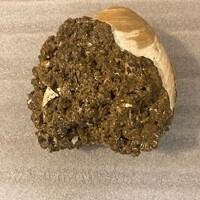
Clams are a staple on Hatteras Island, which is famous for its Hatteras Style Clam Chowder, a clear-broth soup unlike other cream-based chowders in America. Clamming in the waters around Cape Hatteras is done both comercially and individually. Walking around in the shallow, still, waters of the sounds which border the western shore of the Outer Banks for an hour with a clam rake and a basket will usually yield enough clams for a tasty appetizer. As a species, clams have been around for millions of years. In 1982, Kill Devil Hills resident Theresa Rogers found one such clam while gardening in her yard. The prehistoric clam is over five inches wide, has a concretion of shells and other sediment attached to one side of it, and dates to the Pleistocene epoch, which lasted from 2.5 million years ago to 11,700 years ago.