-
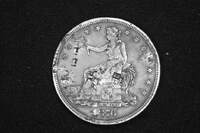 Trade Dollar
 William Barber Trade Dollar “Type II”, 1876, silver, approximately 38 millimeters in diameter.
Front: Lady Liberty, facing left, wearing chiton and coronet, seated on shipping bail on shore with water in background. Her right arm is extended and holding an olive branch, while the left arm at her side holds
shafts of wheat and a scroll inscribed LIBERTY. The scroll at the base of the figure is inscribed IN GOD WE TRUST. The figure of liberty is encircled with
six stars on the left and seven on the right. The date, 1876, is between the bottom scroll and a dentilated border. The surface has four to five chop marks.
Reverse: an eagle, wings spread, facing front, with its head to right. The right talon clutches an olive branch, and the left talon
clutches a group of three arrows. The motto 420 GRAINS. 900 FINE. indicates that the coin weighs six one-hundredths of a pound, or just under an ounce, and is nine-tenths pure silver. The mint mark
“S” (barely legible) for San Francisco, us located below motto 420 GRAINS. 900 FINE. and above TRADE DOLLAR arced along the bottom rim. UNITED STATES OF AMERICA encircles the upper half of eagle. Above the eagle’s head is a scroll with the country's motto E PLURIBUS UNUM. The surface has nine chop marks.
During the mid- and late 19th century, Chinese merchants in port cities accepted only old-style Mexican pesos. American importers had to pay a premium of up to 15% to get these coins in order to conduct business. In response, the California legislature petitioned the Congress to mint special, overweight silver dollars for the China trade. The Mint Act of February 12, 1873 authorized the Trade Dollar denomination. Unfortunately, a last-minute rider (to benefit the silver lobby) gave the coins legal tender status in the United States for all transactions up to five dollars which led to disastrous abuses. On July 22, 1876, Congress revoked legal tender status, but mintage continued for two more years.
Chop marks are very common on these coins and a standard practice of Chinese merchants. Such marks indicate weight and fineness of the piece has been checked and found suitable for use as money. Because the Chop Marks would cut through the surface to expose the color of the metal beneath, merchants could expose those copper coins which had been silver plated.
-
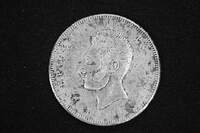 Ecuadorian Sucre
 Five Sucres from Ecuador, A. D. 1943, silver, approximately 38 millimeters in diameter. Front: bust of Antonio Sucre, facing left, circumscribed by REPUBLICA DEL ECUADOR 1943 (Republic of Ecuador 1943).
Reverse: flag draped arms of Ecuador are in the center, with a mint mark of Mexico City and “Mexico”, directly beneath. Circumscribed across the top is GRAM. 25 • CINCO SUCRES • LEY 0.720, meaning twenty-five grams [weight of coin], five sucres [denomination of coin], and by law 0.720 silver content.
-
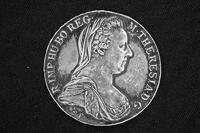 German Silver Coin
 Also known as a Thaler, or Taler, from the reign of Empress Maria Theresia, 1780. It is silver, and measures approximately 42 millimeters in diameter.
Front: bust of Maria Theresia, wearing tiara, facing right, S · F · signature left of center beneath bust which are the initials of two Günzburg mint officials, Tobias Schöbl (S) and Joseph Faby (F). Legend: R· IMP · HU · BO · REG · M · THERESIA · D · G· Romanarum Imperator Hungariae Bohemiaeque Regina Maria Theresia Dei Gratia. Meaning "Roman [Holy Roman] Empress Queen of Hungary and Bohemia Maria Theresia by the grace of God."
Reverse: Imperial double-headed Eagle, arms of Austria at the center surrounded by four quarters representing Hungary, Bohemia, Burgundy, and Burgau (Günzburg). Legend: BURG · CO · TYR · 1780 · Χ ARCHID · AUST · DUX · (Archiducis Austria Duxis [Ducis] Burgundia Comes [contesse] Tyrolensis 1780. Meaning "Archduchess of Austria Duchess of Burgundy Countess of Tyrol 1780."
Following the looting of Aztec and Inca riches by Spain, the booty of the conquistadors was mortgaged to Germanic bankers and large silver coins became popular. On September 21, 1753, Empress Maria Theresia (mother of Marie Antoinette) signed a coinage convention with the Prince Elector of Bavaria. This treaty fixed the silver content of every coin and the exchange ratio between the Gulden and the Thaler at two to one; a raised security edge was added to prevent clipping. The story of the Maria Theresia Thaler is unique in the history of numismatics; it is one of the most beautiful, famous, and wide spread silver coins in the world. The first Thaler was struck in 1741 and was the currency of the Empire and Austrian hereditary lands. It became the trade dollar for the world. Since 1781, the coin has been restruck with the date 1780; the last date of original issue and the year of the Empress’s death. As late as 1980, it was a defacto currency in the Middle East and northeast Africa. Restrike thalers have come from thirteen different mints from
London to Bombay. Noting the pearls around the brooch, the small cross after the date, and the sharp edge and crisp definition of the security legend, this specimen may be dated to the 1920’s.
-
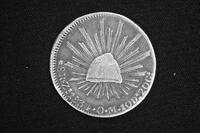 Mexican Liberty Cap and Ray, 8 Reales
 A round, silver, 8 Reales coin, approximately 37mm in diameter.
Front: Mexican eagle, facing right, holding snake in beak and raised left talon, right leg extended, talon clutching cactus perch; lower half of circumference edged with laurel design, upper half semi-circumscribed with legend: REPUBLICA MEXICANA.
Reverse: liberty cap backed with sun rays. Legend arcing along lower rim: *8R-Zs 1834-O-M-10Ds 20Gs.
8R = 8 reales. Z = state mint at Zacatecas. Date of 1834. OM = the initials of the assayer. 10Ds =10 dineros. 20G = 20 granos (pure silver was 12 dineros, each dinero was divided into 24 granos; so 10Ds 20Gs = .902777 fine silver).
-
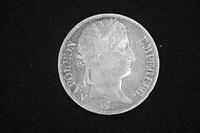 5 Francs
 Round 5 francs from the reign of Napoleon I. The coin is about 37mm in diameter and made of silver.
Obverse: bust of Napoleon, laureate,
facing right.
Legend: NAPOLEON EMPEREUR [Emperor Napoleon].
Reverse: the denomination 5 FRANCS. is in the center, encircled by a wreath and the legend: EMPIRE FRANÇAIS. The date, 1812, arcs along the rim beneath a wreath and the mintmark A (for the Paris mint) to the right of date. A rooster privy mark is to the left.
-
Silver coin
Round silver coin 30,6 mm Half Dollar commemorating Columbia Exposition of 1892 in Chicago. On front, profile of head of Columbus looking left. On reverse, see Santa Maria under sail with waves & 2 hemispheres
-
Silver coin
Round silver coin 30,6 mm Half Dollar commemorating Columbia Exposition of 1892 in Chicago. On front, profile of head of Columbus looking left. On reverse, see Santa Maria under sail with waves & 2 hemispheres
-
Silver Dollar
Large round silver dollar called Liberty head or Silver Dollar, 38 mm diameter. Obverse features profile of head of Lady Liberty in Grecian style with date; reverse shows American eagle grasping olive branches and arrows with motto "In God We Trust." with New Orleans mint mark
-
Silver Dollar
Large round silver dollar called Liberty head or Silver Dollar, 38 mm diameter. Obverse features profile of head of Lady Liberty in Grecian style with date; reverse shows American eagle grasping olive branches and arrows with motto "In God We Trust." with New Orleans mint mark
-
Silver Dollar
Large round silver dollar called Liberty head or Silver Dollar, 38 mm diameter. Obverse features profile of head of Lady Liberty in Grecian style with date; reverse shows American eagle grasping olive branches and arrows with motto "In God We Trust."
-
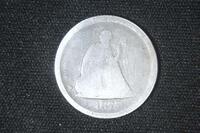 Silver Twenty Cent Piece
 Silver twenty cent piece, 22 mm in diameter.
Obverse: Liberty head turned to the left, wearing chiton, seated on a rock, left hand holds pole bearing Liberty Cap, right hand supports shield of the United States with scrolled motto LIBERTY, thirteen stars arc above and surround the figure, the date, 1875, in exergue.
Reverse: eagle with outstretched wings in center, left talon holds an olive branch. The right talon holds three arrows. Two interlaced, capital “C”s, mint mark for Carson City, just below crossing of branches and arrows clutched by eagle and above the “Y” in “TWENTY”; denomination, TWENTY CENTS, arcs along rim at base.
Legend: UNITED STATES OF AMERICA arcs above and surrounds eagle. Coin is extremely worn.
A twenty-cent coin, also called a “double disme” had been proposed as early as 1791 but found to be impactable. In February 1874 Senator John Percival of Nevada introduced a bill authorizing coinage of twenty-cent pieces. The Senator’s motives remain unclear but were probably influenced by western silver strikes and the 1873 Mining Act. Designed by William Barber, the coin proved universally unpopular. Minted for circulation only from 1875 to 1876, a bill repealing authority to manufacture these coins became law on May 2, 1878.
-
Silver Spanish Milled Dollar
Silver Spanish 2 reales, round, about 28 mm in diameter. Depicts bust of Charles IIfacing right, labeled "CAROLUS III DEI GRATIA 1782. Reverse shows arms of Castile and Leon surmounted by the crown of Spain between the pillar of Hercules. Round, silver coloring. similar to .005, but 1 year later.
-
Silver Spanish Milled Dollar
Silver Spanish 2 reales, round, about 28 mm in diameter. Depicts bust of Charles IIfacing right, labeled "CAROLUS III DEI GRATIA 1781. Reverse shows arms of Castile and Leon surmounted by the crown of Spain between the pillar of Hercules. Round, silver coloring.
-
Silver Spanish Milled Dollar
Silver Spanish milled dollar or 8 reales, round, about 1.5" or 3.8 cm in diameter. Depicts bust of Ferdinand VII, facing right, labeled "FERDIN VII DEI GRATIA 1820" . Reverse shows arms of Castile and Leon surmoounted by the crown of Spain between the pillar of Hercules. Round, gray/goldish coloring.
-
Silver Spanish Milled Dollar
Silver Spanish milled dollar or 8 reales, round, about 1.5" or 3.8 cm in diameter. Depicts bust of Charles III, facing right, labeled "CAROLUS III DEI GRATIA 1783" . Reverse shows arms of Castile and Leon surmoounted by the crown of Spain between the pillar of Hercules. Round, gray/silver color.Similar to .002, but nick on edge above "DEI" and great abrasion of surface. Same size, denomination & age.
-
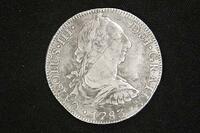 Silver Spanish Milled Dollar 1
 Silver Spanish Milled Dollar also called the “pillar dollar” or eight reales.
Obverse: bust of Charles III, cuirassed, caped, laureate, facing right, circumscribed by legend: CAROLUS • III • DEI • GRATIA • 1783 • Meaning "Charles the third by
the grace of God 1783."
Reverse: arms of Castile and Leon surmounted by the crown of Spain between the Pillars of Hercules
(representing the Straights of Gibraltar), the pillars bear the motto: PLUS ULTRA (more beyond) referring to the world beyond the Mediterranean, entire motif circumscribed by legend: HISPAN • ET • IND • REX • Μ • 8R • F • F • (Hispaniae et Indiae Rex [king of Spain and India], M = Mexico City mint mark, 8R = eight reales, F F = the assayer’s mark).
-
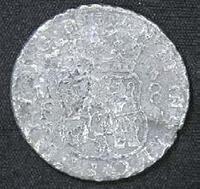 Silver Spanish Milled Dollar 2
 Silver Spanish Milled Dollar, also called the "pillar dollar" or 8 reales. It depicts arms of Castile and Leon with crown, marked PHILIP V D G HISPAN ET IND REX, meaning "Phillip the fifth by the grace of God king of Spain and India."
Reverse side shows 2 globes with the crown of Spain and ocean waves.
This particular coin, though badly eroded, shows evidence of attempted clipping (to cut the coin into “bits” or “pieces of eight”).
Pieces of eight were created when Spanish dollars were cut into eight pieces to make change. This was a popular practice in the British colonies, since they were not allowed to mint their own currency. Colonists often ran out of English money, so pieces of eight were their solution.
-
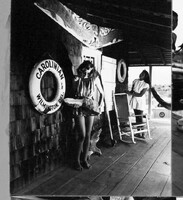 SD Barnes
-
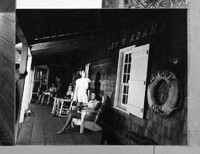 Shipwreck House-Geo M Adams
-
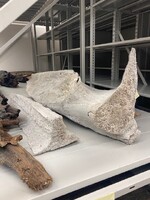 Whale bones
 Large whale ribs and jaw bone, probably from sperm whale
-
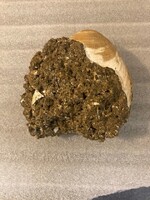 Prehistoric Clam
 Prehistoric clam, partially covered with concretion.
Biological species: Mercenaria campechiensis.
This species of clam is still found primarily along the coast of the Atlantic Ocean from North Carolina down to Florida.
Found in the backyard of the donor, Theresa Rogers, in Kill Devil Hills, NC.
-
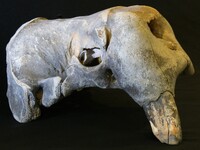 Walrus skull
 Skull from a walrus, dated to 38,000 years ago via Smithsonian; part of the tusks survive. Brought up in shrimp net off the coast of Kill Devil Hills half a mile off the Wright Brothers memorial beach.
-
 Flora Rogers
 The schooner was stranded on Bodie Island on the coast of North Carolina in 1908. All seven people onboard survived.
The nameboard has a dark brown/gray background with yellow lettering and detail.
-
 W Wells
 Backed on white board, this is only part of the nameboard, it is missing the first name, "George."
The George W. Wells was a 6-masted schooner that ran aground in 1913. It is believed to be the largest wooden ship ever wrecked on the Outer Banks. The Wells was driven into Ocracoke Island by hurricane force winds on September 3, 1913. After seven plus hours of working with several lifesaving stations, all 26 passengers and a Saint Bernard dog were rescued and brought to shore.
The wreckage of the Wells can still sometimes be seen on the shore of Ocracoke, where it has lain since it was set on fire, several days after it was sold at auction.
-
 Geo M Adams
 The Adams became stranded off of Bodie Island on June 30, 1897. As the wreck neared the beach, the crew of 8 men were brought to the safety of the shore.
Resources on the ship were later salvaged by the captain, and the ship was sold at public auction.