-
Halfpenny
Halfpenny from the reign of King George II, made of copper and 28mm diameter with barely visible bust of king on obverse and Britannia seated with shield on reverse-- images largely obliterated.
-
Halfpenny
Halfpenny from the reign of King George II, made of copper and 28mm diameter with barely visible bust of king on obverse and Britannia seated with shield on reverse-- images largely obliterated.
-
Halfpenny
Halfpenny from the reign of King George I, A.D. 1717-1719, featuring bust of George I facing right; reverse is symbol of Britannia seated holding shield, olive branch and spear. Legend is "GEORGIUS REX"
-
Halfpenny
Halfpenny from the reign of King William III, made of copper and 28mm diameter with barely visible bust of William III on obverse and Britannia seated on reverse-- date and images largely obliterated.
-
Madonna Denar
Silver Madonna Denar of Matthias Corvinus or Maddonnenmunzen, 15 mm in diameter. Front (obverse) shows quartered shield with Hungarina, Dalmationa and Bohemian Arms. MATHIA (S) on right /R / VNGAR. Reverse: Virgin crowned, facing left toward Christ Child with K L PATRONA VNGARIE (Patron of Hungary)
-
Coronation Tram
Silver coronation tram of Levon I., AD 1198, 20 mm in diameter. Obverse shows 2 figures inside a pearlate border: virgin Mary on left & Emperior Levon w/crown kneels w/left arm extended to receive the Holy Spirit. Hand of God reaches down from heaven to release a dove/Holy Spirit. Legend on outer circle says "Levon King of all Armenians." Reverse shows 2 rampant lions with cross on staff between them. Outer circle legend : by the Will of God.
-
Follis
Follis coin, round of copper and about 27 mm in diameter from the reign of Constantine X, Ducas and Eudocia (empress). Obverse features a front facing Christ standing on a footstool with nimbus cruciger (halo with cross), holding book of Gospels in both hands. In field to left: ι¯с (Ιέσυς – Jesus), in field to right: x¯с (χριστος – Christos or Christ); Legend says: ЄΜΜΑΝΟVΗΛ ( Emmanuel- God is with us). On reverse is Eudocia on left, Constnatine on right, front facing, each wearing a crown and loros and holding between them a labarum (banner, flag or standard) mounted on three steps and with a cross on the shaft ; Legend says: ΕVΔΚ (eudoc – eudocia), rest of legend is not visible.
-
 Roman Copper Coin
 Large copper coin, known as a "Follis" from the reign of Emperor Maurice Tiberius, 588-89 CE.
The front shows bust of the Emperor crowned, cuirassed, facing front, and holding globus curciger (an orb with a cross) and a shield.
On the reverse is a large 'M' (denoting the denomination of 40 Nummi) between columnar arrangements of: A/N/N/O to the right, and columnar arrangement of ‹l/ l l to the left. ANNO and numerals together represent the regnal year, in this case the seventh regnal year, hence the date 588/89. The Μ is surmounted by a cross and, beneath, the officina β denotes the division of the mint responsible for the issue of the follis. Below, NIKO designates the Mint of Nicomedia ( active 498 CE– 627 CE) as the source of the coin.
Maurice Tiberius, Emperor from August 13, 582 through November 22, 602, is recognized as one of the most dynamic Byzantine rulers. He brought the Persian wars to a successful conclusion and reorganized the Exarchates of Ravenna and Carthage. Unfortunately, he was unable to stop the Slav and Avar advance in the Balkans which precipitated a serious loss of territory and prestige for the empire. In 602, Maurice was overthrown by a military revolt. He fled but was overtaken in Asia Minor and he and his sons were murdered.
-
Pentanummium
Pentanummium from reign of Emperior Honorius, 15mm diameter, almost round; Obverse shows Honorius facing right, draped and cuirassed, wearing diadem. Reverse: Emperior is standing, looking right, holds spear and leaning on shield with left hand. Nike walks toward emperior, righ arm extended, crowning him with laurel wreath: VIRTUS (left) & EXERCIT (right)
-
 Roman Bronze Coin
 Large bronze "Antoninianus" from the reign of Emperor Aurelian, 270-275 CE.
Front shows the bust of Aurelian, who is draped, wearing a cuirass and facing to the left. Circumscribed is IMP C AURELIANUS AUG, meaning "Emperor Caesar Aurelian Augustus."
Reverse: a standing, draped, figure of a sun god (the Emperor), facing left with their right arm extended and holding a whip. The left arm is bent and holding a globe. A star is to the left of sun god, and underneath that is a seated, bound, captive facing left. Circumscribed is SOLI INVICTO ("invincible sun"). A mint mark, KA, is below the sun god's feet.
-
Antoninianus
Large bronze Antoninianus from the reigh of Emperor Gallienus, AD 253-268. Obverse shows bust of the Emperor facing right, circumscribed by the legend: GALLIENUS AUG.. On the reverse is the standing emperor holding implements with legend: AETERNITAS AUG and mint mark.
-
Antoninianus
Large bronze Antoninianus from the reign of Emperor Valerian I. Top shows bust of the Emperor facing right, circumscribed by the legend: IMP VALERIANUS P> F> AUG.]. On the reverse is the goddess Felicitas (denoting happiness and prosperity), leaning on a column, holding a staff with legend: FELICITAD AUGG.
-
 Roman Coin
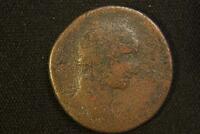
 Large, bronze, Roman provincial coin, approximately 27 millimeters in diameter and minted at Nisibis in Mesopotamia during the reign of Emperor Severus Alexander.
Front: bust of Severus Alexander facing right, with drapery on left shoulder. Circumscribed with AVT KAI MAP AV CE AΛEΞANΔPOC, although wording can no longer be seen.
Reverse: bust of Tyche facing right, turreted, veiled, and draped. The bust is topped by a ram, leaping to the right, with its head looking back, to represent the constellation Aries. A star is to the right of Tyche’s mouth. To the left of Tyche, the wording, CEΠ KOΛO, to the right, NESIBI MHT, although neither can been seen.
Marcus Aurelius Severus Alexander (October 1, 208 to March 18, 235 CE), commonly called Alexander Severus, was the last Roman emperor of the Severan dynasty. He was Caesar under Elagabalus from 221 to 222 CE and succeeded him as Augustus in 222 CE. He eliminated the luxury and extravagance that had formerly been so prevalent at the court. He raised the standard of coinage, reduced taxes, and instituted loan offices for lending money at a moderate rate of interest. He encouraged literature, art, and science and improved conditions for soldiers. He was slain on March 18, 235, in a mutiny of the Legio XXII Primigenia. His death marked the beginning of the chaotic period known as the Crisis of the Third Century: nearly fifty years of disorder, civil wars, economic chaos, regional rebellions, and external threats that brought the Empire to near-collapse.
-
 Roman Silver Coin
 Known as a "Denarius" from the reign of Roman Emperor Hadrian, 128 - 138 CE.
Front: the bust of Hadrian, facing to the right. The words HADRIANVS AVGVSTVS P. P. mean "Hadrian Augustus Pater Patriae and translate to "Hadrian Augustus, father of his country."
Reverse: an unidentified female deity, possibly Vesta, Concordia, or Pudicitia. It reads, COS III to commemorate Hadrian’s third consulship beginning in 119 CE.
Hadrian did not accept the title, Pater Patriae until 128 CE. He was widely regarded as one of the most capable emperors to ever occupy the throne. He devoted his entire life to the improvement of the state, and said to be firm, humane, and a patron of the arts. He died in Baiae (Italy) on July 10, 138 CE.
-
 Roman Coin
 A Roman copper coin, called a "Prutah" dates from 6 CE, when Coponius was prefecture under the Emperor Augustus.
Front: an ear of barley curved to the right. To the left is written ΑΙС and to the right is ΡΟС (ΚΑΙСΑΡΟС = Caesar).
Reverse: an eight-branched palm tree bears two bunches of dates (one to the left and another to the right of the trunk). The L left of the trunk and Λς right of the trunk refer to the date (year 36; struck in the year 6 CE).
-
 Indo-Scythian Coin
 Called a "Drachm" for its size and weight, this coin is from the reign of Azes II, dated from 35 BCE - 5 CE.
Front: a King in armor, facing right, with his right arm raised and extended, holding a whip in his right hand, and mounted on a horse walking right. Kharosthi letter “ ħ” on the right beneath the horse’s head.
Writing, ΒΑΣΙΛΕΩΣ ΒΑΣΙΛΕΩΝΜΕΓΑΛΟΥ ΑΖΟΥ (Basilāōs Basilāōn Megaloi Azoi – "King of Kings Azes the Great") along the outside.
Indo-Scythian rulers were descendants of the Sakas or Scythian nomadic warriors of antiquity and are considered to have eliminated the Greco-Bactrian presence in India. Azes II ruled a kingdom which incorporated parts of modern Afghanistan and Pakistan and was believed to have been centered in what is now Kashmir. Azes II is described as a descendant of Alexander the Great and was, himself, ascribed the appellation “Great”. He was a renowned traveler, explorer, and warrior. His coins were the among the earliest bilingual coins ever minted and continued to be produced twenty-five years after his death. Much of his coinage was minted just before, during the early years of, and remained in circulation throughout, the period of Christ’s life. Some believe Azes II was one of the “three Magi from the East” in the biblical account of Christ’s birth. It is somewhat more certain that St. Thomas the Apostle traveled to India after the Crucifixion, was welcomed into the court of Azes’s successor, Indo-Parthian King Gondopharnes, and founded the Christian Church in India.
-
Drachm
Drachm small silver coin, depicting king Azes II in armor on horse facing to the right with message "King of Kings Azes the Great" with god, Zeus on reverse holding a winged Nike in his hand as he faces left. Kingdom was near India, incorporating some of Afhganistan & Pakistan
-
Diobol
Samll worn bronze coin about 19 mm from ancient Egypt round with head of Zeus-Ammon wearing ram's horn and diadem, facing right and on reverse of coin, 2 eagles on a thunderbolt. Called a "diobol" with writing from reigns of Ptolemy VI and VII.
-
 Egyptian Coin
 Known as a "Hemidrachm," this coin dates to ancient Egypt. Made of bronze, it measured about 39 millimeters in diameter, and is the oldest in the collection, dating from 221-205 BCE.
Front: Head of Zeus-Ammon, wearing a ram's horn and diadem, and facing to the right.
Reverse: it says, ΠΤΟΛΕΜΑΙΟΥ ΒΑΣΙΛΕΩΣ (Tolemāyoi Basilāyōs = Ptolemy King or Ruler). An eagle, wings closed, grasping a thunderbolt in its talons, and head turned to right. A cornucopia tied with fillet is over the eagle's shoulder. The letter Ε is found between the legs.
-
 "Junk" Silver Dollar
 Also known as a Sun Yat-sen silver dollar, or Yuan, from the Republic of China in 1934, this coin measures 39.5 millimeters in diameter.
Front: portrait of former president of the Republic of China, Sun Yat-sen, faces left. The Chinese characters arcs above (reading right to left) “Republic of China 23rd year,” referring to the twenty-third year of the Republic, 1912 + 23 – 1, the first year is included in elapsed time.
Reverse: a Chinese Junk under full sail to the right supported on waves. The Chinese characters (reading right to left) “One Yuan” (equivalent to one dollar).
-
Japanese Coin
Japanese silver coin, round, 38.5 mm, featuring a dragon on the front and 416 ONE YEN 900- in English. (90% silver content), labeled Great Japan; reverse features Chrysanthemum and character meaning one yen.
-
French Coin
French silver coin, about 40 mm in diamester, a piaster de commerce. Seated Lady Liberty with crown resting her left arm on an anchor& tiller; reverse show wreath with writing all around edge, "Indo Chine Francaise"
-
British Trade Dollar
One British trade dollar of silver, round about 39.5"mm, with obverse featuring Brittania from the reign of George V. She holds a shield bearing the British jack and a trident. In the background is a ship under sail. Reverse shows Oriental foliate design, Chinese characters and Malay script., B for minted in Bombay
-
Dragon Dollar
Round silver"dragon" dollar about 39.5mm in diameter with Chinese characters and a circle of beads. Reverse featuers coiled dragon with English writing along edges, indicating the 34th year of ruler Kuang-Hsu's reign. PEI Yang indicates location of mint.
-
 Dragon Dollar
 Round silver "dragon" dollar from Szechuan Province during the reign of Kuang-Hsü. Approximately 39.5mm in diameter.
Front: mark of Chengtu Mint in center surrounded by characters in Chinese and
Manchurian reading (top to bottom, right to left): “Kuang Hsü Yuan Pao”, circumscribed by pearlate border creating an inner and outer circle. Arcing above in the outer circle, Chinese characters (reading right to left) state: “Minted in Szechuen Province.” Small, decorative crosses or stars (one on the left and one on the right) flank the central, inner circle motif. Arcing below, in the outer circle, Chinese characters (reading right to left) describe the denomination: “Equivalent to 7 mace 2 candereens.”
Reverse: in the center of the coin is a dragon with a narrow face and flaming pearl surrounded by stylized clouds, defining an inner circle. Arcing above in the outer circle is the legend: SZECHUEN PROVINCE indicating place and mint of origin. Small, decorative crosses or stars (one on the left and one on the right) flank the central dragon motif. Arcing below, in the lower outer circle, is 7 MACE AND 2 CANDAREENS, noting the coin's denomination.