Trade Dollar
Item
-
Title
-
Trade Dollar
-
Description
-
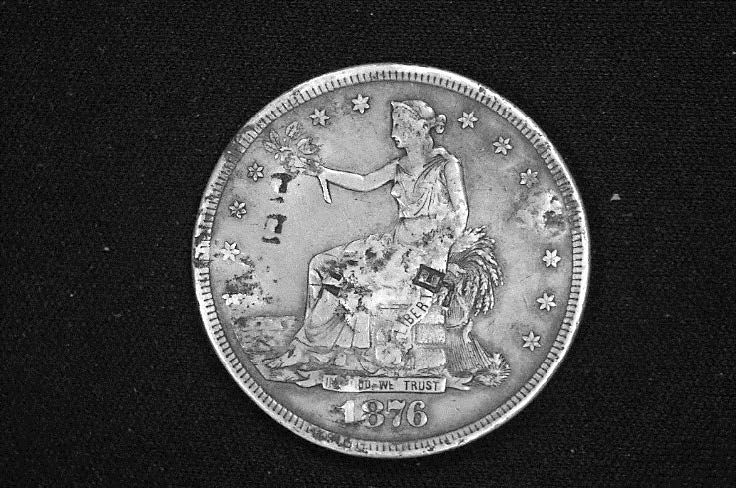
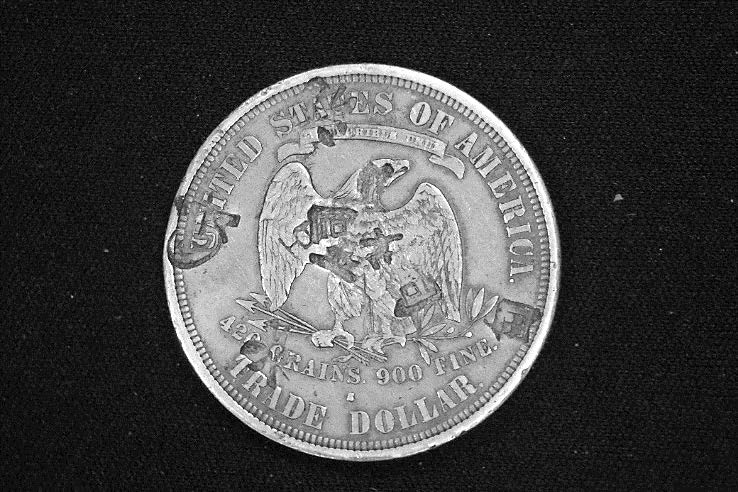
William Barber Trade Dollar “Type II”, 1876, silver, approximately 38 millimeters in diameter.
Front: Lady Liberty, facing left, wearing chiton and coronet, seated on shipping bail on shore with water in background. Her right arm is extended and holding an olive branch, while the left arm at her side holds
shafts of wheat and a scroll inscribed LIBERTY. The scroll at the base of the figure is inscribed IN GOD WE TRUST. The figure of liberty is encircled with
six stars on the left and seven on the right. The date, 1876, is between the bottom scroll and a dentilated border. The surface has four to five chop marks.
Reverse: an eagle, wings spread, facing front, with its head to right. The right talon clutches an olive branch, and the left talon
clutches a group of three arrows. The motto 420 GRAINS. 900 FINE. indicates that the coin weighs six one-hundredths of a pound, or just under an ounce, and is nine-tenths pure silver. The mint mark
“S” (barely legible) for San Francisco, us located below motto 420 GRAINS. 900 FINE. and above TRADE DOLLAR arced along the bottom rim. UNITED STATES OF AMERICA encircles the upper half of eagle. Above the eagle’s head is a scroll with the country's motto E PLURIBUS UNUM. The surface has nine chop marks.
During the mid- and late 19th century, Chinese merchants in port cities accepted only old-style Mexican pesos. American importers had to pay a premium of up to 15% to get these coins in order to conduct business. In response, the California legislature petitioned the Congress to mint special, overweight silver dollars for the China trade. The Mint Act of February 12, 1873 authorized the Trade Dollar denomination. Unfortunately, a last-minute rider (to benefit the silver lobby) gave the coins legal tender status in the United States for all transactions up to five dollars which led to disastrous abuses. On July 22, 1876, Congress revoked legal tender status, but mintage continued for two more years.
Chop marks are very common on these coins and a standard practice of Chinese merchants. Such marks indicate weight and fineness of the piece has been checked and found suitable for use as money. Because the Chop Marks would cut through the surface to expose the color of the metal beneath, merchants could expose those copper coins which had been silver plated.
-
Identifier
-
2008.036.017
-
Source
-
USA
-
Subject
-
Numismatics
-
Provenance
-
William and Catherine Sell
-
Date Created
-
1876 CE
-
Is Part Of
-
Graveyard of the Atlantic Museum