-
Silver Dollar
Large round silver dollar called Liberty head or Silver Dollar, 38 mm diameter. Obverse features profile of head of Lady Liberty in Grecian style with date; reverse shows American eagle grasping olive branches and arrows with motto "In God We Trust." with New Orleans mint mark
-
Silver Dollar
Large round silver dollar called Liberty head or Silver Dollar, 38 mm diameter. Obverse features profile of head of Lady Liberty in Grecian style with date; reverse shows American eagle grasping olive branches and arrows with motto "In God We Trust." with New Orleans mint mark
-
Silver Dollar
Large round silver dollar called Liberty head or Silver Dollar, 38 mm diameter. Obverse features profile of head of Lady Liberty in Grecian style with date; reverse shows American eagle grasping olive branches and arrows with motto "In God We Trust."
-
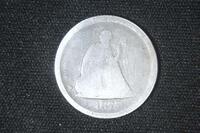 Silver Twenty Cent Piece
 Silver twenty cent piece, 22 mm in diameter.
Obverse: Liberty head turned to the left, wearing chiton, seated on a rock, left hand holds pole bearing Liberty Cap, right hand supports shield of the United States with scrolled motto LIBERTY, thirteen stars arc above and surround the figure, the date, 1875, in exergue.
Reverse: eagle with outstretched wings in center, left talon holds an olive branch. The right talon holds three arrows. Two interlaced, capital “C”s, mint mark for Carson City, just below crossing of branches and arrows clutched by eagle and above the “Y” in “TWENTY”; denomination, TWENTY CENTS, arcs along rim at base.
Legend: UNITED STATES OF AMERICA arcs above and surrounds eagle. Coin is extremely worn.
A twenty-cent coin, also called a “double disme” had been proposed as early as 1791 but found to be impactable. In February 1874 Senator John Percival of Nevada introduced a bill authorizing coinage of twenty-cent pieces. The Senator’s motives remain unclear but were probably influenced by western silver strikes and the 1873 Mining Act. Designed by William Barber, the coin proved universally unpopular. Minted for circulation only from 1875 to 1876, a bill repealing authority to manufacture these coins became law on May 2, 1878.
-
Silver Spanish Milled Dollar
Silver Spanish 2 reales, round, about 28 mm in diameter. Depicts bust of Charles IIfacing right, labeled "CAROLUS III DEI GRATIA 1782. Reverse shows arms of Castile and Leon surmounted by the crown of Spain between the pillar of Hercules. Round, silver coloring. similar to .005, but 1 year later.
-
Silver Spanish Milled Dollar
Silver Spanish 2 reales, round, about 28 mm in diameter. Depicts bust of Charles IIfacing right, labeled "CAROLUS III DEI GRATIA 1781. Reverse shows arms of Castile and Leon surmounted by the crown of Spain between the pillar of Hercules. Round, silver coloring.
-
Silver Spanish Milled Dollar
Silver Spanish milled dollar or 8 reales, round, about 1.5" or 3.8 cm in diameter. Depicts bust of Ferdinand VII, facing right, labeled "FERDIN VII DEI GRATIA 1820" . Reverse shows arms of Castile and Leon surmoounted by the crown of Spain between the pillar of Hercules. Round, gray/goldish coloring.
-
Silver Spanish Milled Dollar
Silver Spanish milled dollar or 8 reales, round, about 1.5" or 3.8 cm in diameter. Depicts bust of Charles III, facing right, labeled "CAROLUS III DEI GRATIA 1783" . Reverse shows arms of Castile and Leon surmoounted by the crown of Spain between the pillar of Hercules. Round, gray/silver color.Similar to .002, but nick on edge above "DEI" and great abrasion of surface. Same size, denomination & age.
-
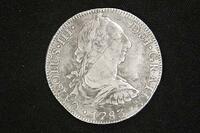 Silver Spanish Milled Dollar 1
 Silver Spanish Milled Dollar also called the “pillar dollar” or eight reales.
Obverse: bust of Charles III, cuirassed, caped, laureate, facing right, circumscribed by legend: CAROLUS • III • DEI • GRATIA • 1783 • Meaning "Charles the third by
the grace of God 1783."
Reverse: arms of Castile and Leon surmounted by the crown of Spain between the Pillars of Hercules
(representing the Straights of Gibraltar), the pillars bear the motto: PLUS ULTRA (more beyond) referring to the world beyond the Mediterranean, entire motif circumscribed by legend: HISPAN • ET • IND • REX • Μ • 8R • F • F • (Hispaniae et Indiae Rex [king of Spain and India], M = Mexico City mint mark, 8R = eight reales, F F = the assayer’s mark).
-
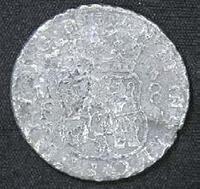 Silver Spanish Milled Dollar 2
 Silver Spanish Milled Dollar, also called the "pillar dollar" or 8 reales. It depicts arms of Castile and Leon with crown, marked PHILIP V D G HISPAN ET IND REX, meaning "Phillip the fifth by the grace of God king of Spain and India."
Reverse side shows 2 globes with the crown of Spain and ocean waves.
This particular coin, though badly eroded, shows evidence of attempted clipping (to cut the coin into “bits” or “pieces of eight”).
Pieces of eight were created when Spanish dollars were cut into eight pieces to make change. This was a popular practice in the British colonies, since they were not allowed to mint their own currency. Colonists often ran out of English money, so pieces of eight were their solution.